Showing posts with label Poetry. Show all posts

Saturday, July 9, 2011

“Censorship feels like it’s mutilating my organs”

Thanks
http://www.sampsoniaway.org/blog/2011/06/20/filmmaker-leena-manimekalai-%E2%80%9Ccensorship-feels-like-its-mutilating-my-organs%E2%80%9D/

Madhuchhanda Ray Choudhury


In January 2011, the Indian Censor Board banned the screening of Leena Manimekalai’s film Sengadal, The Dead Sea. Depicting the plight of Tamil fishermen refugees as they flee a war ravaged Sri Lanka into India, Sengadal, like Manimekalai’s eight other films, gives voice to an oppressed community.
Only after a long and exhausting legal battle was Sengadal recently cleared for public exhibition with an A rating (for adult audiences only). Manimekalai feels “this is a moment of victory for one’s artistic freedom. This confirms that art prevails over the state’s power.”
A strident supporter of artistic freedom, Manimekalai refuses to confine herself to a single creative medium. Apart from being an independent film maker, Manimekalai has also penned three poetry collections. Her films have won accolades in film festivals both in India and abroad and have been screened by many social activist groups. Hailing from Tamil Nadu, India, Manimekalai’s art is a rebellion against caste and gender persecution.
In this interview with Sampsonia Way, Manimekalai reveals how her past shaped her artistic vision and explains the challenges that plague her as she strives to retain an independent voice.
……….
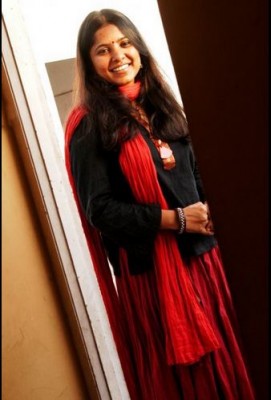
You were originally trained as an engineer. What turned you towards film-making?
I am a madwoman, and my vision is an open sea. I never wanted to be someone counting the boats going by. In fact, I am number blind. Additions, subtractions, multiplications and divisions appear like double lies to me. As a child, I pretended to be good at math and science just to keep my parents happy. As a middle class girl of a ‘third world’ family, when you get qualified and enrolled in a professional degree, you can only do ‘n’ number of things, and your family questions your actions less. But I hate a secure life. One’s mind stops working when ‘secured.’
When I started my independent life, I stopped trying to make others happy and started chasing myself through writing, cinema and being in love. Of course, this was a difficult and unsafe choice, but I decided to be faithful to my desire and freedom of choice. I happily abandoned my Instrumentation Engineering and started following my intuition. Now I am able to question inequalities, resist oppression and strive towards change.
What was your childhood in India like?
I was born into a farmer’s family, south of Tamilnadu, in a village called Maharajapuram at the slopes of the Western Ghats of the Virudhunagar district. My late father was a Tamil professor and the first to earn a degree in our family. My mother is a real earthy soul with an unlimited spirit and energy. I went to school in an urban Anglo-Indian Convent where I was strictly scheduled by early morning athletics, eight hours of subject classes, two hours of bharathanatyam (dance), one hour of carnatic music, and weekend hindi classes. However, my body always resonated with my aimless summer life of cattle, pagan gods and goddesses, the occult, Sathuragiri hills, rain-fed rivers, deep wells, cycling, swimming, stealing fruit, and the kittipuli (country games) in my village. A gypsy inside me wakes up the moment I think of my home.
How did your sense of revolution grow out of this environment?
All of the men in our family seemed to be interested in revolution and practiced hard-core left politics. They held district-level, state-level and national-level positions in the Communist Party of India. The women in the household ran the kitchens, cattle and paddy fields to make a living. I guess all my questioning and rebellion started from that point of conflict. The other major issue is India’s caste system. I refused to identify with my family, or any community which directly stamped on me a caste and put me as inferior to some and superior to others. This hierarchical system, which enrolled me for a life I didn’t choose, has made me question my very existence.
.
You started your career with several large media companies in India. What was that like? Why did you instead turn to documentary film-making?
In two years during my early twenties, I switched jobs 11 times. I was never loyal to companies. The canonical figures of mainstream cinema were so feudal I did not belong to them as an apprentice; either they spit me out, or I left. But cinema as a tool of expression still captured my imagination. Digital cinema was a democratic, independent space not dictated by the market, and its possibilities enthused me in a way the industry did not. Independent cinema can help someone find their voice; it is also for people who want to be heard. I am perpetually seeking both of these things, so I attached my body to a handy-cam, microphone and mac-book, and started my endless drive toward exposing society’s hidden truths and dark places.

Photo: The Hindu
Your film Parai on caste discrimination, specifically on Dalit women, was cut 19 times by the Indian Censor Board. Could you talk about that experience?
The experience with Parai is intriguing. It was more a movement than a piece of video. Yes, the censor board demanded 19 cuts of a 40-minute film, which I set aside. But the film was also presented to the National Women’s Rights Commission and the National Human Rights Commission. The commissioners were forced to take action against the censorship since they were featured in the film taking petitions from the affected Dalit women. Seventeen oppressors were arrested by the District Collector, and the issue gained momentum. Thousands of copies of the film were made and distributed state-wide for advocacy and awareness programs.
Censorship is an insult to a thriving society and it feels like it’s mutilating my organs. It ceases my being. Religion, State, Caste, Culture, Gender, Language, and every other institution are monstrous agents of censorship. I resist, and that gives me some reason for hope.
Despite the Censor Board’s decision, you managed to screen the film by alternative means in about 200 villages. How did you do it?
I short-circuited myself from the mainstream outlets and travelled to hundreds of villages with a set of DVDs, a player and a projector. I showed films on the white walls of corporation schools, on the loins of villagers and on street corners at night. People were always willing to talk, share and debate over the work; this participatory dialogue is what completes my films. I owe all my understanding of my society and people to my experiences of screening films. Each screening is both a process of learning and unlearning.
Do you have a moral or artistic philosophy toward making and screening your films?
I only choose subjects in which I can also place myself as a subject without any compromise. Dealing with a community is not like dealing with actors. I have to be more responsible and committed to fight until the end. I do this with all of my energy, even when I don’t get anywhere. I do not believe change happens in one night through one film. Change is a long process. This is why I attempt to create a participatory dialogue with my films. I experiment, and sometimes I fail, but the idea is to seek answers collectively. Only when all the elements—the film, its maker and the audience—participate and interact equally, does the film attain its fullest form.
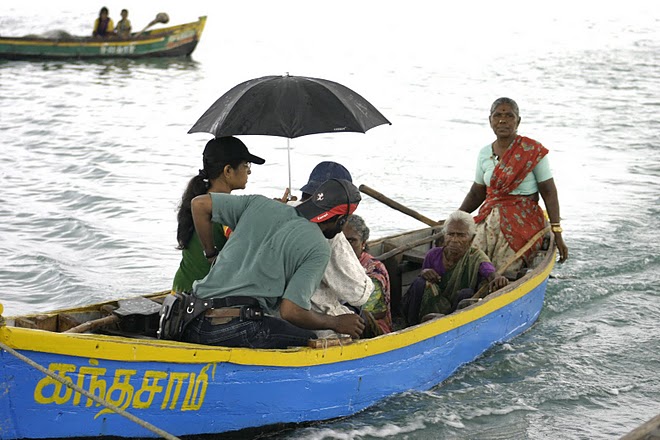
Manimekalai with Sethurakku, a fish hunter, shooting Goddesses .
Despite highlighting the unflattering lives of certain Indian women, your film Goddesses won the Golden Conch at the government-sponsored Mumbai International Film Festival in 2008. However, your most recent film Sengadal, which deals with the plight of Tamil refugees, has been stayed by the Indian Censor Board. Can you explain the structure of censorship in India?
When the Mumbai Film Festival tried to introduce censorship only for Indian entries, independent filmmakers all over the country stirred against the double standards of the Films Division of India, and the festival had to withdraw their regulations. But still the fight continues with the National Awards and the Indian International Film festival. It is a slap in the face of independent Indian Cinema. Making a film is only half the battle; what use is it if it is not seen?
In India a film needs a censor clearance for both telecast and theatre releases. Why is a filmmaker, who has taken up cinema seriously, denied the right to reach a wider audience? Consequently, why is my audience denied their basic right to see a film uncut? It is a scary situation not only for artists but for all citizens of this “democratic” country. Our basic freedoms of expression are at stake.
In addition to the dozen films you’ve self-produced, you have also published several books of poems. How has the public received your written work?
I still consider myself an evolving poet, but my first Tamil poetry anthologyOtraiyilaiyena (As a Single Leaf) has seen three editions so far. On the other hand, my second book, Ulagin Azhagiya Muthal Penn (The First Beautiful Woman in the World), has invited mixed reactions: It received the Iyal Poetry Award for 2009, a call for its banning by some Hindu People’s Party, and repressive attacks by some ultra left fanatics like Makkal Kalai Ilakiya Kazhagam. My third poetry collection Parathaiyarul Raani (Queen of Sluts) has just been released.
Does you poetry also have enemies?
Obviously, my poetry is dangerous to religious and ideologically fanatic minds. Language is my first enemy; its norms, design and usage are controlled by the dominant patriarchy. My language’s linguistic codes are embedded in a culture- and gender-specific socialization that prohibits women from communicating about issues that are considered socially disruptive. In my work, I try to challenge this structure. I stray from every possible institution because none of them have done justice to women in the whole of human history. Poetry is life and not imitation; if this life is dangerous, then let me face it; for me, safety is slavery.

Thursday, September 9, 2010

Vagina Tamilogues

Brief version

Times of India
Do you think the works of such women poets have helped widen society's views on women's bodies in some way? Do you see more women becoming aware of their bodies and not being ashamed of it because of reading such texts?

Leena Manimekalai
Ofcourse yes, I would say.Body for a woman in this patriarchal moralist society is a Prison. There is a constant  vigilance by institutions like say state,religion,family,caste on a woman's body. Her roles as a wife, mother, sister and likes are inscribed in her body. When women resist the construct and try to write as an act of subversion, she is again left with the patriarchal tool called language. When a woman becomes aware, questioning arises, conflict intensifies, change evolves. Poetry certainly helps women to become self aware. Lot of my women readers particularly young women readers have written and spoken to me about how poetry helped them to negotiate the guilt  they have been conditioned about their bodies, desire and identities.

Times of India
Are you seeing more women poets emerging in this field? Women like Salma, Kutti Revathi and Malathi Maithri gained fame in the early 90s for their work but have you seen younger entrants in the field since then?


Leena Manimekalai
It is not early 90s. It is in the beginning of 2000. This is the period when non Brahman and Dalit women  came as a force in tamil literary expression. It is an out burst of long history of oppression and denial to knowledge, arts and expression to them..About young entrants, yes for me, they(Malathi,Kutti Revathi,Suganthi Subramanaim) were there with the lanterns. Now I am here , as an electrode. There will be someone who will be a cyborg down the lane.

Times of India
How have you approached the subject of women's bodies in your work? Can you give us a few details about such projects?


Leena Manimekalai
For me, poetry is translating desire. I kind of try and challenge the existing design. I drink my menstrual blood when someone says, it is impure. I would recommend a piercing in clitoris when someone comes with a knife to do genital mutilation.  I am attracted to both women and men and am pro choice with regards to sexuality. I write this, I practice the same and try to live free. I can only talk about change, when I live free. As an artiste, Its impossible for me to be faithful to power structures including ideologies. And I detest censorship.
If all this is comprehended as living dangerous, I am happy, I have chosen it. Because safety is slavery.


Times of India
Could you tell us in detail what 'Ulakin Azhakiya Muthal Penn' is about? What stirred the controversy with Hindu Makkal Katchi? Why was the content referred to as 'obscene'?

Leena Manimekalai
 There is an asymmetrical relations between woman and language whose norms and usage are controlled by dominant patriarchy. The problem lies with the linguistic codes that are embedded in a culture - gender specific socialization that prohibits women from speaking or writing about issues that are potentially considered socially disruptive. Desire can be a dirty word to some religious and ideological fanatics but not to a poet.Maybe, for them true indian respect to women is  equivalent to treating them asexual. Religious definitions of "obscenity" "indecency", slip to dangerous propositions like moral policing and result in a threat to freedom of expression. This puritanical notion neither liberate or empower women or men not nurture art.

Times of India
Your blog mentions you took up a visual arts fellowship with PSBT on Tamil women, poetry and desire through the ages of Sangam, Medieval and Modern Periods. Could you tell us about that? Did you come across any interesting findings?


Leena Manimekalai
A man forges his early creative work from the expanse of his imagination and from the world of abstractions traversed by his mind. In contrast, a woman, I believe, mines the boarded-up space that is her body for words and offers them to the world. As a means of protesting the silence into which it has been coerced, the female body keeps imprinting on itself all the seasonal changes being wrought continuously by Nature.The film will explore the passionate language of women writers in Tamil literature from Sangam to Contemporary times who know where to situate their bodies, themselves and their poetry. It would like to explore how the body emerges in their poems as something they own but as something that is constantly put in a space that falls within both the private and public spheres. The film will be interested to interpret how these poems see the body both as a site of struggle and celebration. Birth, death and love get written on the body and also violence, violation and power.. The film will try and imprint the enigmatic envision of sensuality in Sangam to present Tamil women poetry.

Times of India
Finally, could you talk to us about your future projects?

Leena Manimekalai
My current project is Sengadal(www.sengadal.com), which is my debu fiction feature film, and scheduled to be completed by September end. My PSBT fellowship film should be finished by this December and am also at the moment compiling my third collection of poetry "Parathaiyargalin Raani"i.e "Queen of Sluts" in English. 


Karthika Gopalakrishnan for Times of India  

Published Version


Friday, January 29, 2010

The calm cool face of the river asked me for a kiss, Poetry

Translations of few of my recent poems.


1.

Animal Show


He wore a shirt
That cannot be removed easily.
Its black and white stripes
Proclaim the certainty of
numerous animals hidden behind
When confronting truths
buttons rip open
and tigers snarl and bite.
When the friendly chirps of birds surround
stripes thaw out an ancient sword
Slash the voice
dipping it in blood.
It is heard
that the corpses do not like
This shirt that supervises nudity.
Because the skin’s ripeness
Can’t be smelt
Fairies too
Reject the appeals
For the untying of the body’s knots
His shirt pockets resembling screens
are full of nurses.
For the putrefying
foul smelling wounds
the tongue gives heat
The nurses occasionally
Tear the shirt along the hairlines
And crawl.
The shirt not easily strippable
Captures and retains
     His buttocks
     Scrotums
     Secretions
     Erections
Like memory.


2.


What do you want?

Finally when I met him
He happened to be a fish
In my ocean he swam
With millions of scales
Never once did he
Get caught in my fingers.
Whenever he plays the brown blue serpent gourd
And convulsions die down
He drinks my spirit.
In his thirst
I kept drowning
Whenever I tried to grab
His light-ball face
with dark mossy lips
he slipped away
With the ease of a snake.
Asked him to let me know at least
Which part of my body he liked
He snatched my breasts
And disappeared.
Now I am scorching
Like a desert.


3.


The Ocean that exceeded the tongue

Like a bamboo forest
My lust rattles.
The one who lit a fire with wetness
Had gone leaving behind his tongue
Whether it is a storm
Or rain
Or infernal fire
The air is befuddled.
In the embrace
Giant waves shattered like
Magical birds
In the scream of a cruel voice
The earth turned musical.
The one who swallowed the ocean
flutters like a butterfly.
The play continues.


Poems translated from Tamil by Rajaram Brammarajan


A brief about R. Brammarajan, Transalator.


Rajaram Brammarajan is a poet, translator, critic and editor. He started writing poetry in the late 70s and brought out his first collection of poems Arindha Nirandharam (Known Eternity) in 1980. His last collection of poems was called Zen Mayil (Zen Peacock)[2008]. So far he has published 7 volumes of poems. His Selected Poems (2004) contains selections from all his collections excepting one. His keen involvement in the process of poetry and poetics led to the writing of essays ranging from Modern Tamil poetry to Anti-poetry of post-war Europe. All his essays on poetry are collected in the book titled Vaarthaiyin Rasavatham (Alchemy of the Word)[2008]. He edited the notable anthology called Contemporary World Poetry (2008)spanning all countries excluding America and England. His full-length introduction to Ezra Pound was published in 1985. In 1987 he presented to the Tamil readers a selection of Bertolt Brecht with a highly structured introduction.

His translations include Jorge Luis Borges’s Stories (2000) and Calvino Kathikal (Stories of Italo Calvino). His translation of Gabriel Garcial Marquez’s One Hundred Years of Solitude is forthcoming. He has also translated from Tamil into English many younger poets. For Sahitya Akademi’s Indian Literature he translated a selection of Siddhar poems. (“Second Tradition: SIDDHAR POEMS”, Indian Literature, Jan-Feb 2000).

He occasionally writes columns on Indian music. He edited a quarterly magazine MEETCHI (Retrieval) since 1983. By the time when the magazine was defunct in 1992 he had published 35 issues that have made a strong impact on the sensibilities of modern Tamil literary world. He started another little magazine under the name Naangam Paathai (Fourth Way) in 2008. This little magazine has extended its roots to other arts like music and painting. Its 3rd issue is forthcoming.

He has conducted a couple of workshops for upcoming poets in different parts of Tamil Nadu. He has also been instrumental in the planting and preservation of 13,000 trees in the Government Arts College campus.

He was born into a peasant family and was educated in government colleges and completed his post-graduation in English from the Annamalai University (1975) with distinction and University First. Later he completed his M.Phil in Bharathiar University specializing in the novels of Samuel Beckett. In M.Phil too he secured the first rank. He is based in Dharmapuri, a sleepy small town in Tamil Nadu. He is Associate Professor and Head of the Department of English in Government Arts College, Dharmapuri.

He can be reached at his email: bramoraj@yahoo.com


And some more to follow


1. Me

me leenaa

i reside in
Lankai Indiya Cheena
Amerika
Affrika Sarayevo
Bosniya Turky
Irak Vietnaam Boliviya
Romaniya

i have a flourishing career-
to keep my legs spread
at all times

They who demand new nations
They who give the call to jihad
They who look for revolution
They who wage wars
They who demand their share of the empire
They who evangelize commerce
They who wear saffron
They who rob
They who are sick
Whoever They are

i am trained to
inflame their hardy lust
with pruned labia
groomed black hole vagina

my mother grandmother aunts-
they have instructed me
from time to time
on how to mop up
the goo that collects
in gallons
between my legs

i know
the secret of
how the pricks of
the knowledgeable the sick the artist
the lumpen the broker the emperor the commander
the thief the computer wizard the warrior
the dope peddler the medic
the wage labourer the sailor the farmer
the husband the father the brother the son
all look the same.

i know no language
no skin tone
no elite ways country flag government
culture army law currency
take a good sniff at them
to get the stench
of my blood.

Brahman Vishnu Sivan Budhan,
Jesus Allah Indran Krishnan,
Sooryan Karuppachamy Ayyanar,
Incarnations Epics Classics
are nothing but
the embryos
stuck in my Womb
despite efforts to abort.

nuclear bombs chemical warheads,
rockets landmines
the grenades flung at me
may shatter my body.

but,
the Vagina knows no death.
Nothing dies in the Vagina.


2. Me Him

at the peak of coitus
with the squirting semen
he inscribed my insides
with the word
Comrades

then with a shake of his body
he disentangled himself
and blabbered
Marx
and gave the call
Workers of the World Unite

i yanked his head
betwixt my thighs
he parted my pubic bush
calling it the surplus value
swore at my navel for its relations of production

he offered my vulva with
Lenin Stalin Mao Ho chi Min

kneaded my breasts and exclaimed Che Fidel
like an infant with a baffled mind
sucked at my nipples murmuring
Perestroika Glasnost

some time with fire in his loins roared Revolution
and with quickening breaths gasped Socialism
gave me his prick to suck

The Berlin Wall crumbled.
The Soviet collapsed.
Stand Erect he commanded.
Yelled America and rolled on a condom.

wrestled him down
and asked him to lick the salt.

he mumbled Coca Cola

hugged him till he swooned.

into his mouth
now drained of words
i threw my pubic hair
strand by strand

and beamed Deconstruction

October Poems

1.
Am looking for her
who parted my breasts in twain.
Were you the one

Was it so that your hands
could both work on them

Or was it because it was more than
one mouthful

It must have been your infantile dream
to stretch a cloth between two hills and
cradle yourself in that

Did not you do that as you cannot stand
the sight of my baby
suckling on it

You say that my child has mistaken
honey for milk

You name it different everyday
to impress me.
Mayflower chithirakkani thorn apple screwpine
Hibiscus lily eggfruit whatnot

Am not able to shoo you away
My nipples grow tender like adolescent girls
at the approach of your
tongue’s desirous touch

The images you make
with your teeth marks
come to life forms
as days pass by

Each day an archaeologist arrives
to buy those organisms
.
The blouses that you tore into
Where do I store the nude

2.

How does he look
A folded page of history

how do you know
he was always in the nude

Did his body resonate
yes, like the middle of the ocean

what did it say
one hundred years of slumber.

Really
yes, inside me, at the mouth to my womb.

did you savour him
the saltiness of sadness.

How
the lines on my tongue were erased.

Clarify
I was conquered.

Why then
self-annihilation.

Did you tell him
no, I did not. I was famished.

how do you feel now
like a dart.

how did you find him
he was in my dreams before.

what does he remind you of
a sea gull.

why do you cry
I cannot forget.

why do you cry
it is crippled in birth.

3.

The moment
you parted
I flung my nudity
at the broken mirror.

poured acid into the chambers of the winds.
scooped up all the torn fragments of my existence
and gulped them down.

I cursed the artists for selling dreams
to go fuck as tapeworms.

Rid poems of their puzzling
adornments
and threw them to the dogs

My bones seethe with rising anger.
Blue cockroach
My lust is a raven plundering the ocean

I swim this torrent of a rain
in search of the spring of your sperm.

Surrender.


Menstrual flowers

To my loveable boatman
I offer these menstrual flowers.
in the roar of the oceans
crevassed by deep kisses
command signals for adventure
hop around like fish.

I give myself to satiate the hunger of eagles.
The blood oozing from the flesh
makes the forests go mad.

the unleashed harpoon’s flight
redefines the drawing’s lines.
in the expanses newly reached
a whirlwind fire spreads.

As the boatman launches his paddle
I name the lands
where languid tuskers are bound.

As the lands of bloodbushes.


Performance

The moment

The shadow
Found my victory stone in the wild spring’s gorge,
Death too
Beheld me.

Like an untamed goat
Of the mesmeric mountain,
My clitoris gorges on bunches of lingua-fruits.

As moisture
Bores through the lightning-scorched tender shoots,
The rope of Death
Whirls above the teeming sprouts
To strike and to draw back for the next.

Legs entangled in the skies,
I shove Death onto his back
And swiftly, as the swishing rope,
Targets the courses of God.

The body, defrenzied,
Commences its rites.


Chichili

Me, a kingfisher
My body, multihued.

When in the mood
I spread my wings
Imaging the sky.

From its lustre will be born
The dark blue rains.
And its yellow fringes will swallow
The untouched fish dozing in it.

I will tear up the wind
And roll the shreds into a brush
And dab paint on the scales of my victims
With a squeeze of Green.

I will now gulp down my hunger
And free the fish to
Frolic in the boat.

Then, spread my mirror wings.
The gawking fish have begun to soar
To report to the colours.


That poem is not with me.

Something that never comes to a close
works against the terrorists

Boundaries,
in the fuses of the linguistic grenades
that speak in different tongues.
Boundaries within boundaries.

This poem does not break any news
Stop the Press.
The Authorities are armed with
the other news.
The readers have been sold out.

Looking for interpretations
in the bunkers.
The television gives out news bullets.
That is when cups overflow with humans.
as coca cola
as bird flu
as the cricket bat
as oversized body bags
as light and sound show.

The War is on.
The war is off.

History alights from armoured vehicles
and walks the streets.

It is neither defeated nor won has need for humans.

This poem is not even like
the final releases from the Government.
Insurance policies, mortgage deeds,
arms in the hands of children.
The word struggling to stop them
is not there in that poem.

It recalls nothing else.

Dollar or Euro
grows in abundance
in nations without countries.
In those global villages
with unmarked dwellings
Cappuccino is served.
Brand new luxury cars
roll out from the paddy fields.
Machines churn out money at a touch.
Nothing to complain

Generally,
as the Americans have reconciled
to their furies,
how to play the game fair
by the book
is now acknowledged
from the dried blood memoirs of Vietnam.

Cambodia
the flea market of Walmart.
Palestine
a hole in the map.
Sri Lanka
a gunboat swaying on the waves.
Burma
void
Iraq
deathtrap

Everything is slotted
after the commercial break.

Nothing to say, nothing to do.
Peace and quiet.

A smile that emanates from the bygone days.

The emperors have left
the pages of the text books.

A brief about Mr.Ravishankar, Transalator.

Ravi Shanker has translated many works from and to English, Tamil, Malayalam and Hindi. English translations include MOTHER FOREST, the life story of C.K.Janu, tribal leader from Kerala, and HARUM SCARUM SAAR AND OTHER STORIES, a collection of short stories by Bama, both published by WOMEN UNLIMITED, DELHI. Published translations to Malayalam include Pedagogy of the Oppressed by Paulo Freire, Accidental Death of an Anarchist by Dario Fo and Michil by Badal Sircar. Translations of Women’s Decameron by Julia Woznesenskaya, Secret Obscenities by Marco Antonio de la Parra and The Visit by Friedrich Durrenmatt are pending publication. Apart from these, some individual works have been published in Indian Literature and anthologies of Dalit writing.

He has written a play Mrithabharatham, performed by Stage, Thrissur. Also, participated as actor, singer and writer in Hindi plays `Om Swaha’, `Ala Afsar’, `Toba Tek Singh’, `Marz se Munafa’, `Pardon ka Parcham’ , ‘Ek Aur Durghatna’, ‘Can’t pay Won’t pay’, performed by Theatre Union, Delhi.

Has participated as actor, singer and co-writer in the play ‘Echoes of Comala’ by Teatro del Momento, a Spanish Malayalam English production for Sangeetha Nataka Akademi, Kerala.

He lives in Palakkad, Kerala. Reachable at shankeran@gmail.com